Load

Your data

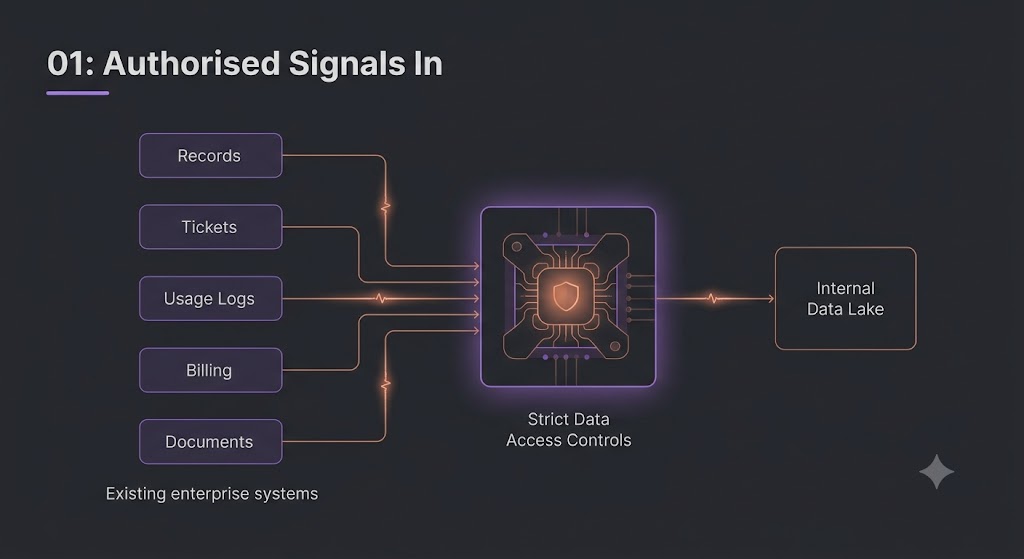
Connectors or approved imports bring in emails, cookies, events, CRM rows, tickets, billing, documents, and outcomes.

Store

The trail

Scout keeps ordered attribution paths in your estate (PostgreSQL/pgvector for proof). Fortress moves heavy load into Rust and LanceDB.

Match

Past outcomes

The Rust engine compares the current path with similar journeys that converted, retained, escalated, delayed, or lost.

Return

A task brief

Checked JSON with top examples, confidence, caveats, and ranked next steps for the goal you asked about.

Explain

Your model or team

Your approved model can explain the brief. It does not invent the plan. Elite covers the leadership walkthrough when needed.

Product / KynticAI Fortress

Private runtime that weights real paths, not text-chunk distance alone.

Fortress is for teams that have proved Scout and now need a private commercial runtime: your connectors, your credentials, your estate, LanceDB path storage, and the Rust engine that weights journeys by conversion and failure. It returns a checked JSON packet to your approved model boundary. The model explains the brief. It does not invent the route.

Keep operational state inside your walls, run outcome path matching in Rust/LanceDB, then deliver validated JSON for next-best-task translation.

Sales path / Fortress private runtime

Fortress turns a renewal-risk signal into a private enterprise action.

Fortress is not just a bigger Scout. It sells the private runtime: more source families, stronger governance, customer-controlled deployment, and JSON handoff to the buyer's approved model boundary.

Question: which recovery action should customer success take when support, usage, billing, and CRM signals disagree?

1. Data in

Approved enterprise signals enter through scoped connectors or imports.

account = northstar-manufacturing.example.invalid

account_tier = enterprise

usage_signal = admin logins down

support_history = unresolved API latency escalation

billing_status = renewal due in 60 days

2. Private analysis

Fortress compares the relationship path inside the customer-controlled runtime.

path = support escalation -> usage decline -> renewal clock

similar_saved_path = engineering response + sponsor call

similar_lost_path = generic renewal email

governance = source trail and role-aware handoff

3. Model-ready JSON

The buyer's model or team receives a governed task package.

primary_action = senior engineer response

secondary_action = account-owner recovery call

defer = renewal ask until service recovery is visible

handoff = approved model boundary

Output

Illustrative Fortress output

Recovery brief: engineering response first, account-owner call second, renewal message later.

Owner route: customer success lead owns the call; support lead supplies the latest latency fix note.

Governance guard: the approved model boundary receives a cited JSON brief, not raw source exports.

Fortress sells the enterprise difference: private multi-system evidence becomes a governed recovery action before the renewal conversation drifts.

Data in, data out

Fortress explains the private enterprise version in the same plain flow.

Fortress takes the Scout pattern into a private runtime. The buyer keeps the operational data boundary, KynticAI analyses approved relationship signals inside that deployment, and the output is governed JSON for the buyer's chosen model or team.

In

Approved enterprise signals enter

CRM, support, usage, billing, document, email, and operational signals enter through scoped connectors or approved imports.

Store

Relationships stay private

The deployment stores source trails, identity links, attribution paths, and relationship facts under the customer's control.

Analyse

Fortress compares the patterns

The private runtime looks for similar saved, lost, converted, delayed, or escalated patterns before a model writes anything.

Out

Governed JSON is handed off

The chosen model boundary or human workflow receives a compact brief with evidence, caveats, and a recommended next task.

Example input

Churn prevention pilot

support case = unresolved API timeout

usage in last 14 days = down

billing status = active

CRM contact = renewal sponsor

Example output

relationship_pattern = support friction plus usage decline

similar_saved_path = engineer response plus account-owner call

next_task = schedule technical recovery call

handoff = JSON to approved model boundary or customer success queue

Buyer result

The customer success team gets a specific recovery action with the evidence trail behind it, while raw operating records stay in the buyer's environment.

Buyer spark

This is where private data becomes private advantage.

Fortress is the moment the enterprise buyer sees the moat: the relationship engine runs close to their systems, compares the patterns fast, and hands their approved LLM the evidence it was missing.

The customer keeps the data estate and model estate they already trust.

Rust/LanceDB turns large relationship sets into ranked next-task JSON.

The LLM stops unstructured inference from fragments and starts explaining from governed evidence.

Plain English

What Fortress does and how the relationships support the next task.

What it does

Enterprise/Fortress runs the private Rust path-weight engine and LanceDB outcome-matching store around Context Engine for exact authorised operational state.

How it works

It runs close to the customer's systems, reads approved event sequences and source structure, stores attribution paths and relationship sets as trajectories, scores them with Rust path weights and LanceDB outcome path matching, and serves schema-validated execution packets without making an external hosted service the data owner.

Commercial value path

It gives security-conscious buyers sovereign state-routing infrastructure: deterministic traversal, private containment, and structured task output their own LLM can only translate.

Task moment

Your approved model boundary receives a validated execution packet for the next best task while operational state and path memory stay under your control.

What you get

The concrete deliverables behind Fortress.

Private runtime plan

Deployment shape for a customer-owned data plane, including where connectors, one-off import packs, source access, the Rust engine, LanceDB path-weight relationship store, JSON output, and audit controls live.

Exact-data connector scope

A governed map of approved systems and fields while credentials and raw operational records stay under customer control.

Discovery MCP buying route

Buyers can run local discovery in their own AI workspace, approve a metadata-only Discovery Signature, and let KynticAI build a synthetic demo against equivalent connector families before the Fortress pilot is scoped.

Proprietary Rust/LanceDB path-weight engine

Relationship weighting, deterministic traversal, recency, contradiction, similar-pattern matching, LanceDB outcome path matching, and confidence scoring. Path weights come from historical conversion and failure, not plain cosine distance on text chunks, before any model translates the next best task.

High-load path-weight runtime

The enterprise path is for millions of relationship path records, concurrent relationship traversal, production observability, and deployment-specific P95/P99 performance targets rather than Scout's proof-scale PostgreSQL/pgvector operational-path store.

Schema-validated execution packet handoff

Strictly validated JSON with provenance, purpose, role controls, caveats, probabilities, ranked route options, and audit trails for the customer's own model endpoint. Downstream models translate the packet; they do not author the decision.

Example data walkthrough

Fast relationship analysis across CRM, support, usage, billing, and outcome signals

Privacy-safe synthetic example backed by a real validation path. Private connector scope, source permissions, and governance are confirmed per pilot.

01 / Private signals

Fortress reads permitted structure in place

email = samira.patel@example.invalid

support_ticket = API timeout

usage_14d = down 29%

billing_status = active

crm_contact = renewal sponsor

The exact authorised operational facts stay inside the customer-controlled runtime.

02 / Governed relationship

Rust links the relationship pattern

attributionPath = ticket -> usage_drop -> billing_active -> renewal_risk

churnRisk = rising

supportDrag = high

similarSavedPattern = resolved support + usage recovery

sourceTrail = CRM + support + usage + billing

The Rust engine and LanceDB path-weight store can compare this account with similar saved and lost relationship sets while raw source records remain in the customer-controlled data plane.

03 / Money move

Customer success gets a next task

recommendedAction = senior engineer response + account-owner call

confidence_band = evidence-supported

value_target = reduce churn risk

handoff = JSON to approved model boundary or customer success workflow

The engagement is framed around relationship-backed retention action with caveats and review ownership.

How it works

The enterprise-grade operational state-routing runtime

Enterprise/Fortress hardens free open-source Scout into sovereign state-routing infrastructure. Private connectors read source structure under customer control; the on-prem compounding memory layer and LanceDB path-weight store keep operational state close; the proprietary Rust engine scores trajectories by historical outcomes; schema-validated execution packets cross the model boundary so the customer's LLM only translates a structured task brief.

Inject

Private connectors and imports

Read SQL Server, PostgreSQL, REST/CRM, email, document, enterprise system metadata, and customer-approved one-off imports as chronological event sequences through the agreed deployment path.

Store

Operational state and LanceDB

Persist identity links, attribution paths, source order, behavioural path vectors, and relationship sets as historical paths inside the customer-owned LanceDB-backed runtime.

Analyse

Path-weight engine, policy, and provenance

Apply proprietary Rust relationship weighting and deterministic traversal, LanceDB outcome path matching, identity, role controls, confidence scores, temporal decay, audit export, and source trails. Algorithmic traversal over distance, not passive retrieval.

Handoff

Validated execution packet to your model boundary

Send schema-validated JSON to the customer's approved model endpoint, such as an internal model, approved gateway, or deployment-specific hosted-provider adapter. The model translates; it does not invent the route.

Deploy

Sovereign operation

Scope deployment for the customer VPC, private infrastructure, Kubernetes estate, or restricted environment with controlled updates and support paths.

What this unlocks

The practical moves that make Fortress worth paying for

Private connectors

Bring enterprise-only systems into the compounding memory layer while keeping credentials and raw records in customer-controlled vaults and data stores.

LanceDB path-weight scale

Move beyond Scout's PostgreSQL/pgvector operational-path proof store into a high-load path-weight runtime for large relationship sets, concurrent relationship traversal, and customer-specific performance validation.

Governance control surfaces

Show source trails and relationship usage without turning the product into an untracked data copy or hosted analytics layer.

Identity integration

Align evidence access with OIDC, SCIM, SAML, RBAC, and enterprise support workflows.

Customer model-boundary handoff

Deliver source-traced, schema-validated execution packets to the customer's own model layer, rather than bundling a KynticAI model inside Fortress.

Operational hardening

Package the data plane for deployment, update channels, audit trails, health checks, and scoped support paths.

Integration points

Designed to sit inside the enterprise stack you already own

Enterprise data

Pilot-scoped SQL, CRM, ERP, document, API, email, and storage systems with connector status verified per engagement.

Security estate

Credential vaults, customer identity providers, role controls, source trails, audit paths, and private deployment topology.

Decision layer

Customer-approved model boundaries such as internal LLMs, approved gateways, deployment-specific hosted-provider adapters, human review workflows, internal agent platforms, GraphQL clients, REST consumers, and BI operational views.

Design partner program · limited seats

A real program: discounted pilot, founder access, roadmap input — for one hard workflow.

We are looking for a small set of partners who need AI that behaves on enterprise data without giving that data away. You get clear commercial preference, direct time with Paul, and a path to a co-branded case study. We get production-shaped feedback on Scout, Fortress, and Elite.

Seats

Limited

Pilot window

60–90 days

Your time

2–4 hrs / month

Pricing

Typically 40–50% off

Preferential pilot pricing

Typically 40–50% below standard commercial rates on discovery and the first Fortress pilot scope, locked for the agreed pilot window (usually 60–90 days).

Direct founder access

Working sessions with Paul on architecture, data boundary, and pilot success criteria — not a hand-off to a scripted sales process.

Roadmap influence

Your workflow helps set connector order, packet shape, and the Scout → Fortress path so the product fits how you actually buy and deploy.

Co-branded case study path

Where both sides agree, we publish a privacy-safe outcome story your industry peers can trust.

Who this is for

  • You help decide how data, AI, or integrations land in the business.
  • You have one workflow where a better next task would matter this quarter.
  • You can approve a narrow, read-scoped source for a pilot.
  • You want data to stay under your control, not shipped into a black-box SaaS by default.

How the program works

  1. 1

    Apply

    Tell us the workflow, systems, and what good looks like in 60–90 days. Leave secrets and raw data out of the form.

  2. 2

    20-min discussion

    We map Scout → Fortress → Elite to your constraints and confirm seat fit.

  3. 3

    Scope + terms

    We lock data boundary, acceptance checks, pilot window, preferential pricing, and feedback rhythm.

Evidence Results

Fortress turns private relationship memory into JSON for your LLM.

These examples focus on the private runtime, Rust/LanceDB scale path, and customer model handoff.

KynticAI Result
Private Runtime

Fortress scenario - connectors, credential boundary, local evidence store

Enterprise relationship analysis without data sprawl

Fortress runs close to customer systems, reads approved source structure, and keeps raw operational data under customer control.
KynticAI Result
Rust/LanceDB

Fortress scenario - millions of relationship sets, fast comparison, traversal

Fast private comparison at enterprise scale

The proprietary Rust engine and LanceDB store compare one relationship path with many similar won/lost, converted/not-converted, or saved/lost examples.
KynticAI Result
Customer LLM

Fortress scenario - JSON to an approved model boundary

Keep the customer's model choice

Fortress sends the relationship output to the customer's approved model boundary, such as an internal model, approved gateway, or deployment-specific hosted-provider adapter.